
At the very core of every Thermomix sits one of its most powerful and misunderstood components: the blade. While it may look simple at first glance, the Thermomix blade is an incredibly engineered tool designed to chop, mix, knead, blend, whip, and mill evenly, all within one compact system.
For many users, especially beginners, the blade can feel a little intimidating. It spins fast, it’s very sharp, and it’s responsible for a huge portion of what your Thermomix can do.
But here’s the good news: once you understand how it works and, more importantly, how to use it correctly, that intimidation quickly turns into confidence.
The blade isn’t something to be nervous about; it’s something to respect and learn from. It’s the heart of your Thermomix, doing the hard work behind the scenes. From chopping vegetables in seconds to kneading dough, blending silky soups, or whipping up dips and sauces, the blade is what brings everything together.
When you learn why to use different speeds, when to reverse the blade, and how it interacts with each function, you unlock the true power of your machine. What once felt overwhelming becomes second nature.
And that’s when the magic happens.
This guide will give you a complete overview of the Thermomix blade
The Thermomix blade is a multi-functional, stainless-steel, four-pronged blade, positioned at varying heights at the base of the mixing bowl. This layered design allows it to move through ingredients efficiently, ensuring even mixing, cutting, and blending every time.
Unlike standard kitchen blades, which are typically designed for a single task, the Thermomix blade is engineered for versatility. By simply adjusting the speed, changing the direction, or adding an accessory, it can perform a wide range of functions, from chopping and blending to kneading and gentle stirring.
Designed to cut, mix, and circulate ingredients simultaneously, reducing the need to stop and scrape down the bowl.
Forward motion chops and blends, while reverse motion gently stirs without cutting, ideal for delicate dishes.
Works seamlessly with the Thermomix heating system, allowing you to cook and mix simultaneously.
Reaching speeds of over 10,000 RPM (depending on the model), the blade can create smooth soups, sauces, and purees in seconds.
This combination of design and functionality is what allows your Thermomix to replace multiple kitchen appliances, from food processors and blenders to mixers and even parts of your stovetop cooking.
Understanding how the blade behaves at different settings is key to mastering your Thermomix.
At higher speeds, the blade creates a vortex, pulling ingredients down and evenly processing them.
One of the most important features is the reverse (anti-clockwise) motion:
The Thermomix blade isn’t just sharp; it’s incredibly precise. It’s been engineered to deliver consistent results across a wide range of cooking tasks.
It works to
This combination is what makes Thermomix cooking so reliable. Recipes turn out the same way every time, which is a huge advantage whether you’re just starting out or cooking with confidence every day.
Knowing when and how to use the blade correctly will transform your cooking.
Use Higher Speeds When:
Use Lower Speeds When:
Use Reverse Mode When:
It’s completely normal to feel cautious around the blade, but it’s designed with safety in mind.
Once you get comfortable, handling the blade becomes second nature.
Q: Can the Thermomix blade cut you?
Q: Which way does the Thermomix blade turn?
Perfect for protecting delicate ingredients.
Q: When should I use reverse mode?
Use reverse mode when you want to protect texture. It’s ideal for cooking meat, pasta, rice dishes, or anything you don’t want chopped.
Q: What speed should I use?
Choosing the right speed controls how the blade behaves and the texture of your final result.
Q: Can the blade cook food?
Not on its own, but it works together with the Thermomix heating system to cook and stir at the same time, giving you even, consistent results.
Q: Why does the Thermomix create a vortex?
At higher speeds, the blade pulls ingredients down into a vortex, circulating them continuously through the blades. This creates smooth, even textures without needing to stop and stir.
Q: Do I need to sharpen the Thermomix blade?
No. The blade is designed to stay effective over time through its shape and speed rather than traditional sharpness. If performance drops significantly, replacement is recommended instead of sharpening.
Q: How do I clean the Thermomix blade?
Follow the pre-clean in the modes screen on your Thermomix, which is designed to clean the bowl and blade efficiently.
Alternatively, use the Turbo clean method: add water to the top of the shaft of the blade along with a drop of detergent, then run Turbo or a high speed for a few seconds. This safely cleans around the blade without needing to touch it.
Q: Can I remove the blade?
Yes. The blade is removable for a full clean. Always remove it by holding the shaft of the blade, not the edges.
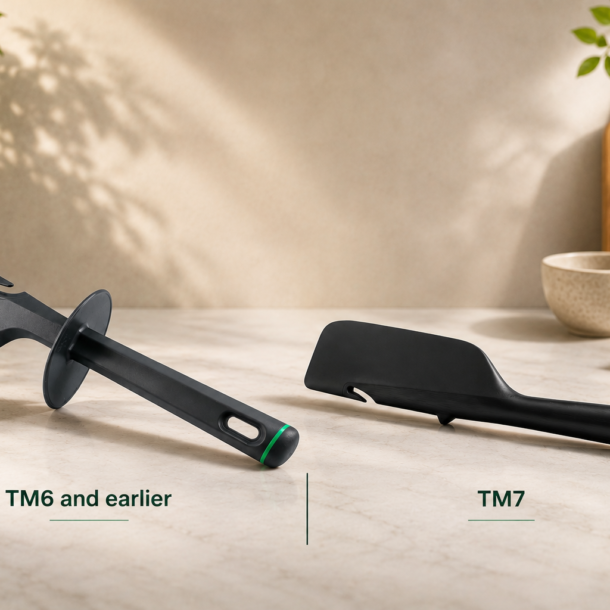
On TM6 and earlier models, twist the base of the bowl to the left to release the blade. You can either:
Always handle with care and avoid touching the sharp edges.
Q: Why is the blade at different levels?
The staggered blade design allows ingredients to be processed evenly and efficiently, ensuring nothing gets stuck or missed during mixing or blending.